
Even though it could feel slightly counterintuitive, oftentimes sustainable innovation fails at ameliorating the overall adverse environmental impact induced by a combination of technical, systemic, and behavioral factors. In turn, this contributes to a slowed down process in efficiency improvements concerning particularly high-scale industries. While individual products tend to be labeled as ‘greener’, the aggregate production and consumption waste continue to dramatically rise. This article explores the limitations of sustainable innovation and its link to the rebound effect in modern business models.
The Rebound Effect (Jevons Paradox)
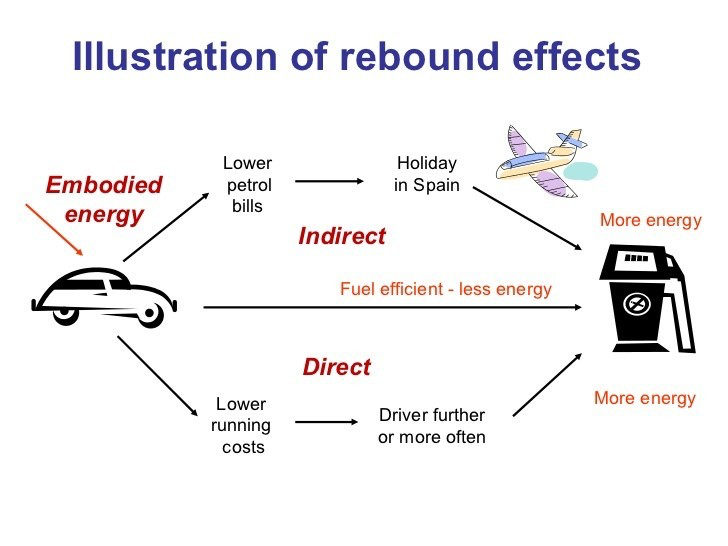
The term rebound effect refers to ‘the unexpected effects of improvements to resource efficiency, productivity or conservation – not predicted by engineering analyses – on the use of these resources due to socioeconomic and behavioural responses’. The idea behind the concept implies that an energy efficiency improvement causes a reduction in costs of the service provided, which in turn, drives its own demand, further increasing the use of the resource in question. Additionally, even when no further demand is generated, the monetary savings can be used in the consumption of other goods and services. Both situations constitute a problem for public policy, hinting at counterproductive energy and climate policies.¹
Defining the Jevons Paradox
The rebound effect is commonly expressed as the percentage of the forecasted reduction in energy use that is ‘lost’ due to the sum of the consumer and market responses. To illustrate, consider a home device with annual electricity use of 100 kWh/year. Suppose a more efficient one reduced consumption by 10 kWh/year off this total before accounting for any consumer and market responses. If these responses increased electricity use by 1 kWh/year, then the rebound effect would be equal to 10 percent (1 of the 10 kWh per year in expected energy savings would be ‘taken back’ due to the consumer and market response).³
The Aviation Industry
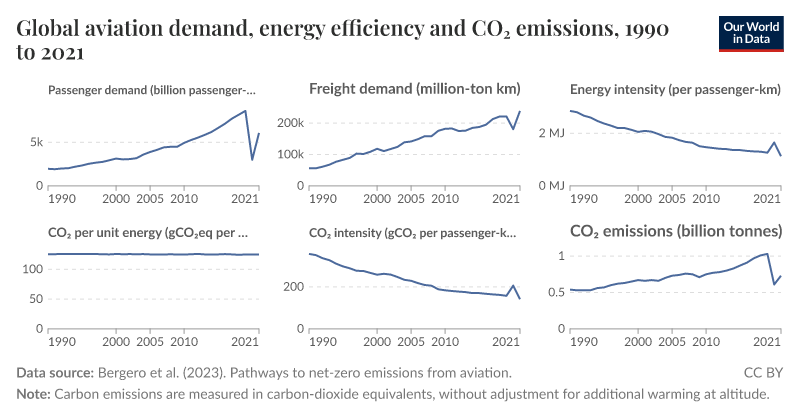
The continuous increase in air passenger traffic leads to a rise in atmospheric emissions, which proves to be a crucial impediment in achieving net-zero emissions by 2050 as proposed by the EU Climate Law. Hence, the transition must involve a systemic change.⁵
Research on the aviation rebound outcome estimates that an average of 19% of predicted energy savings from more fuel-efficient aircraft were offset by a growth in air travel demand caused by more accessible pricing strategies and an expansion of the industry. Although technology improves, behavioral responses of passengers lead to a strong boost in air travel, negating the potential sustainable benefits, with long-run effects prospectively reaching 49%. This suggests that high-tech advancements alone are insufficient to meet climate goals without first addressing demand rise using predetermined economic strategies.²
The Technology Industry
Furthermore, a similar phenomenon could be recorded in the digital industry. The use of AI applications expands on the term to create the ‘Spare Time Rebound Effect’. As an example, if a fully automated robotic vacuum mop takes over the cleaning, people have more free time, yet they fill it with energy-intensive activities. Similarly, energy savings are counteracted by higher energy costs for server infrastructure. Moreover, longer battery life for tablets may be the result of transferring energy consumption to cloud services and the data centers that power them. ⁴
In conclusion, the inefficiency trap caused by the rebound effect challenges one of the most widely held assumptions in the sustainability world: efficiency alone is able to reduce environmental impact. However, an analysis of particular industries demonstrates that improvements in performance often stimulate additional demand due to lower costs, offsetting part of the predicted benefit. For businesses, this does not diminish the importance of innovation, instead, it redefines its role. Ultimately, efficiency must be complemented by strategies that address total consumption through new models and regulatory frameworks aimed at shifting consumer behavior.
Written by Sabina Turcan
Citations:
- Art. “Jevons’ Paradox Undermines Green Innovation | Jaume Freire-González.” IAI TV – Changing How the World Thinks, 24 Aug. 2023, iai.tv/articles/jevons-paradox-undermines-green-innovation-jaume-freire-gonzalez-auid-2585
- Evans, Anthony. “ScienceDirect – the Rebound Effect in the Aviation Sector – Google Search.” Google.com, 2018, www.google.com/search?client=safari&rls=en&q=ScienceDirect+%E2%80%93+The+rebound+effect+in+the+aviation+sector&ie=UTF-8&oe=UTF-8
- Gillingham, Kenneth, et al. “The Rebound Effect and Energy Efficiency Policy.” SSRN Electronic Journal, vol. 10, no. 1, 2015, environment.yale.edu/gillingham/GillinghamRapsonWagner_Rebound.pdf , https://doi.org/10.2139/ssrn.2550710
- Hille, Hauke. “The Rebound Effect – SustAIn.” SustAIn, 5 Nov. 2023, sustain.algorithmwatch.org/en/the-rebound-effect/
- Joint Research Centre. “Reducing Air Travel Climate Effects Requires More than Technological Innovation and Carbon Pricing.” EU Science Hub, 9 Dec. 2024, joint-research-centre.ec.europa.eu/jrc-news-and-updates/reducing-air-travel-climate-effects-requires-more-technological-innovation-and-carbon-pricing-2024-12-09_en