The transition to clean energy is accelerating. With an increased effort to curb the use of fossil fuels through net-zero targets, entire industries are being reshaped as coal plants have been closing all across Europe and renewable capacity expanding at a record speed. Although incredibly beneficial for the environment, the fossil fuel industry has provided stable employment for generations of workers, and a steady tax base for communities throughout multiple countries. The decrease in demand for fossil fuels therefore has significant implications for workers in fossil fuel sectors, whose employment circumstances are being affected by these structural shifts in the energy market.
The concept of “just transition” formalized by the International Labor Organization (ILO) refers to the process of “greening the economy” in a way that creates new employment opportunities and minimizes harm to workers and communities. It is a recognition of the fact that climate policy carries real social costs, especially in the labor market, and that these costs should not fall disproportionately on the workers that are often unequipped to handle them.
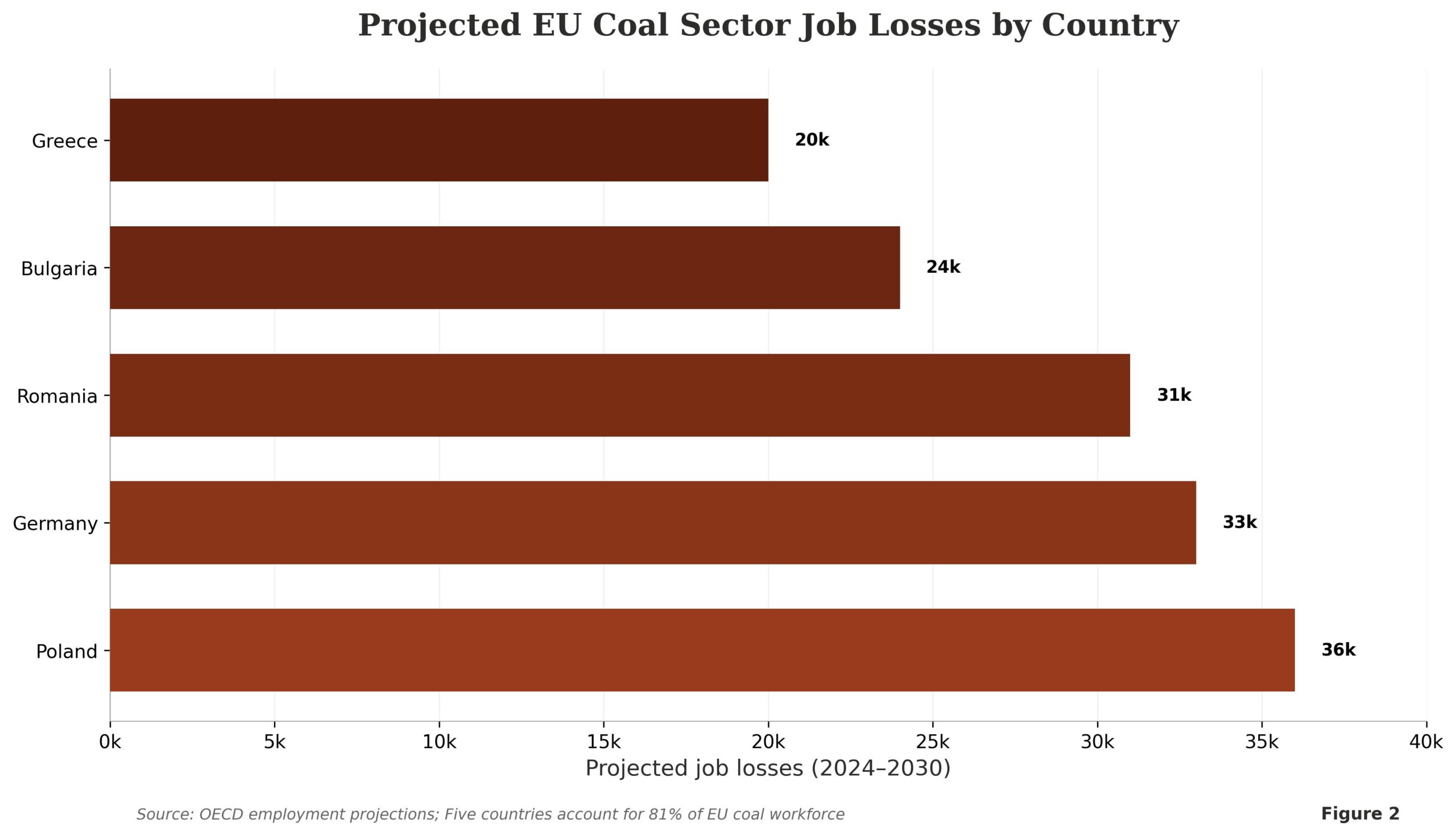
According to projections by the Organization for Economic Cooperation and Development (OECD), around 154,000 jobs in EU coal mines and power plants will be lost by 2030. The countries most exposed are Greece, Germany, Poland, Romania and Bulgaria, which in total employ around 81% of the EU’s coal workforce. Beyond coal, oil and gas workers face a slower but equally structural decline, with clean energy employment already exceeding fossil fuel employment globally. Global Investment in clean energy has additionally grown substantially, while fossil fuel investment has remained relatively static.
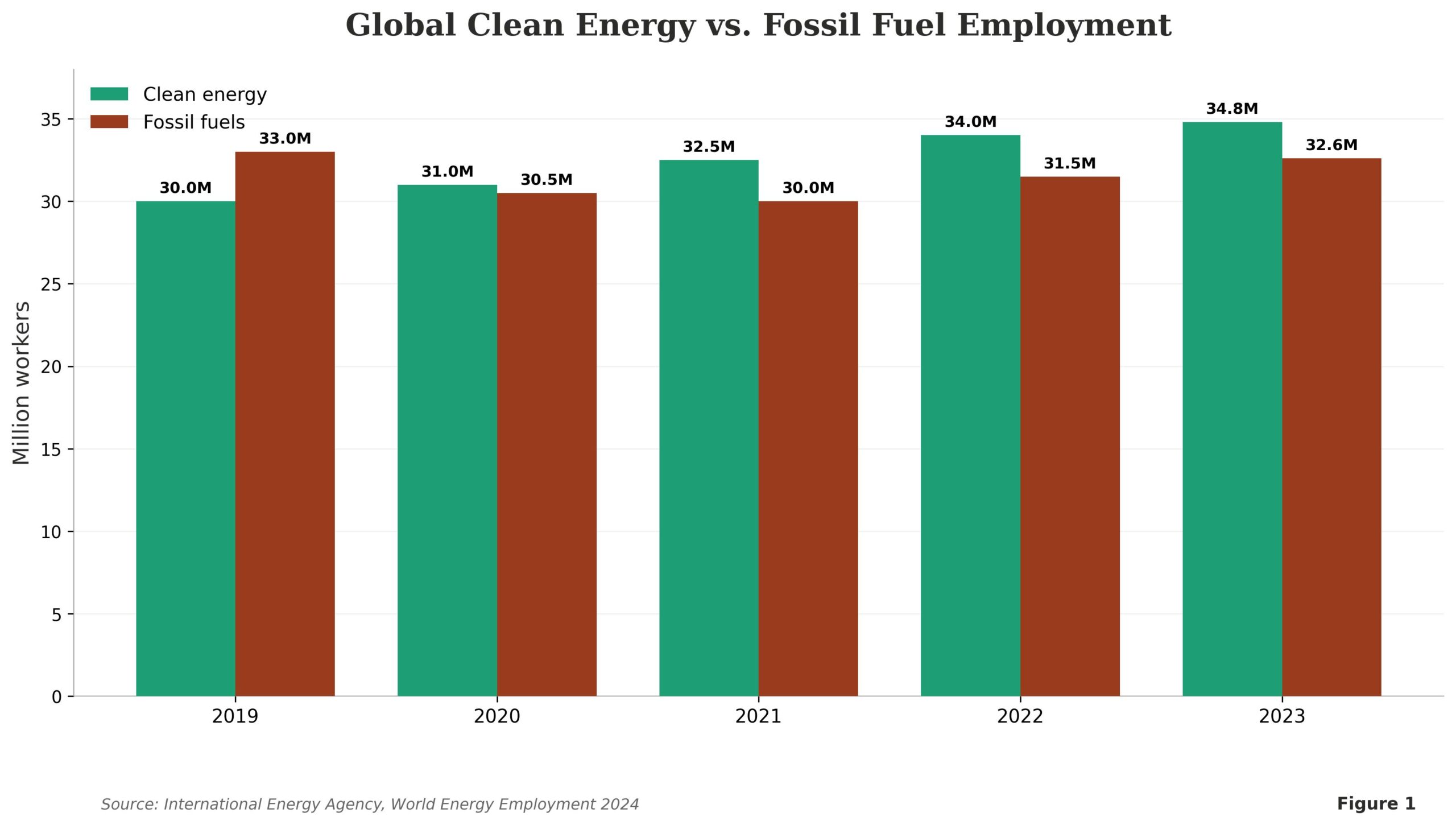
As shown in figure 1, the International Energy Agency (IEA) data indicates employment reached 34.8 million workers globally in 2023, compared to 32.6 million in fossil fuels. Although it is found that workers can leverage their mobility to other industries, especially considering they have similar skills to green occupations, many fossil fuel extraction workers are not located in regions where green employment will grow despite having the appropriate skillsets. This geographical barrier highlights a large issue in the effort for just transition. While stakeholders in the energy shift focus on re-skilling workers, many are faced with the decision to relocate – a costly and often impractical reality.
To combat these issues and ensure a “just” transition in practice, the ILO published a set of guidelines in 2015 (later reaffirmed in 2023) that identified four fundamental requirements: employment-centered policy, social protection for affected workers, development of skills, and perhaps the most crucial, social dialogue. This need for social dialogue is not only important when investing in decent jobs, but is key in communication between employers, government, and workers when implementing a strategy for just transition.
A 2025 study examining plant closures in Finland and the United States found that when unions were able to advocate for themselves, workers experienced less uncertainty and more stable terms of employment during their transition. In Finland, the closure of the Hanasaari coal plant resulted in the outsourcing of nearly all its 300 blue-collar employees. This contrasted to the closure of the Marathon petroleum refinery in California, where after one year of closure, 26% of laid-off workers remained unemployed and those who did find new jobs often experienced wage losses, changed contracts, reduced protections and therefore more uncertainty. These differences in outcomes regarding employment were attributed to whether or not unions were included in the social dialogue and allowed collective bargaining, explicitly linking lack of labor inclusion to mass unemployment of fossil fuel workers and labor shortages in green sectors.
Focusing more on the European Union and their efforts to implement the policies of just transition, the EU has incorporated just transition as a component of its Green Deal through the Just Transition Mechanism – one that is projected to mobilize at least €55 billion between 2021 and 2027. The mechanism targets coal, lignite, and shale oil regions, covering reskilling programs, investment in new economic centers, development of infrastructures and rehabilitation of former industrial sites.
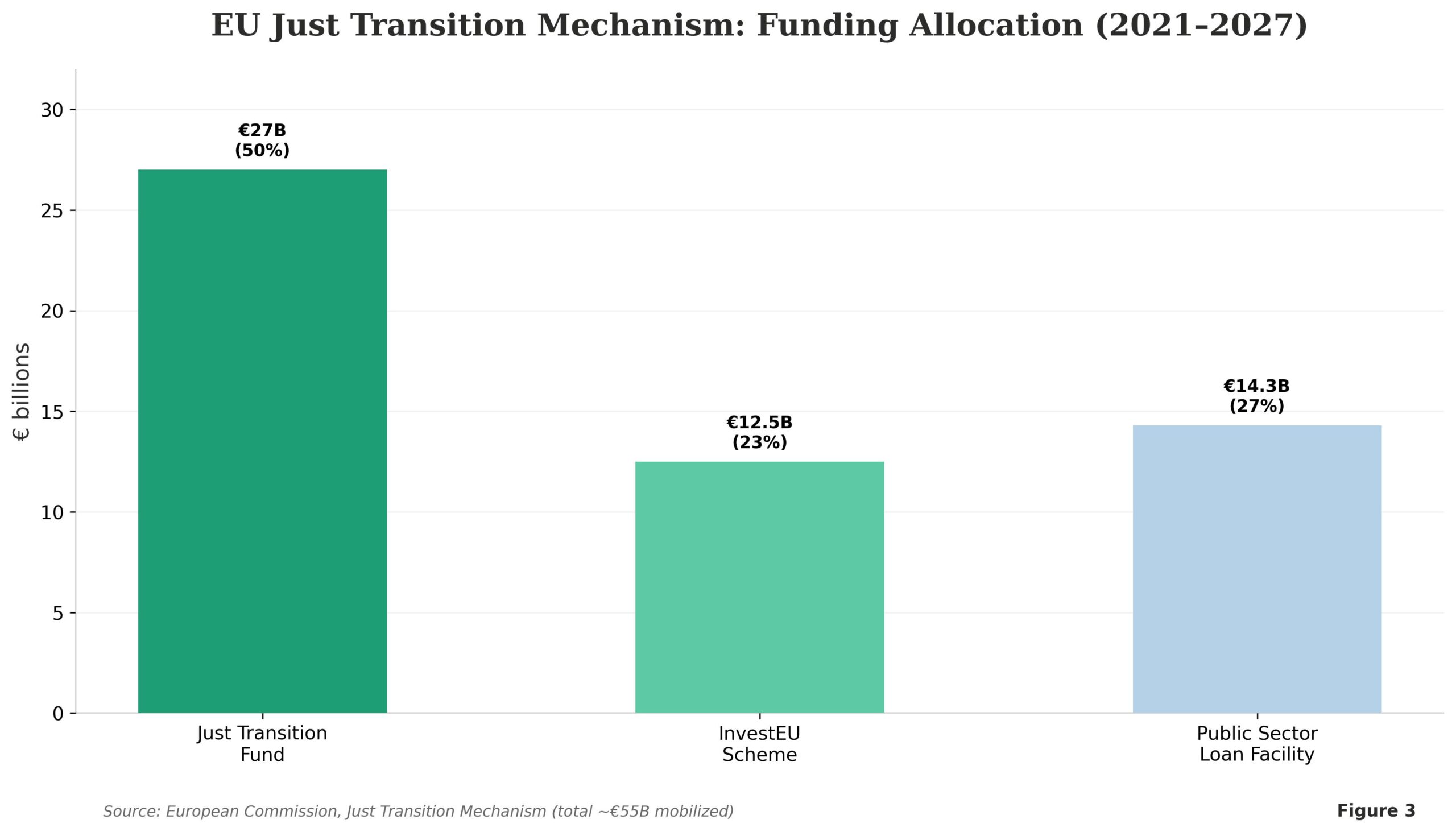
Implementation of this mechanism has varied across regions, and although optimistic, still faces some criticisms. A 2025 analysis by the New Climate Institute found that the transition measures have largely focused on coal-related job losses without addressing deeper structural inequalities (the socioeconomic and environmental disadvantages coal-dependent communities often face) or extending meaningfully to other transitioning industries beyond coal (including that of oil and lignite). Regional programmes in Germany’s Lusatia and Spain’s Asturias have produced promising results, including that of innovation centers, developing support programs for coal workers, and landscape restoration, however these successes are not the norm across all recipient regions.
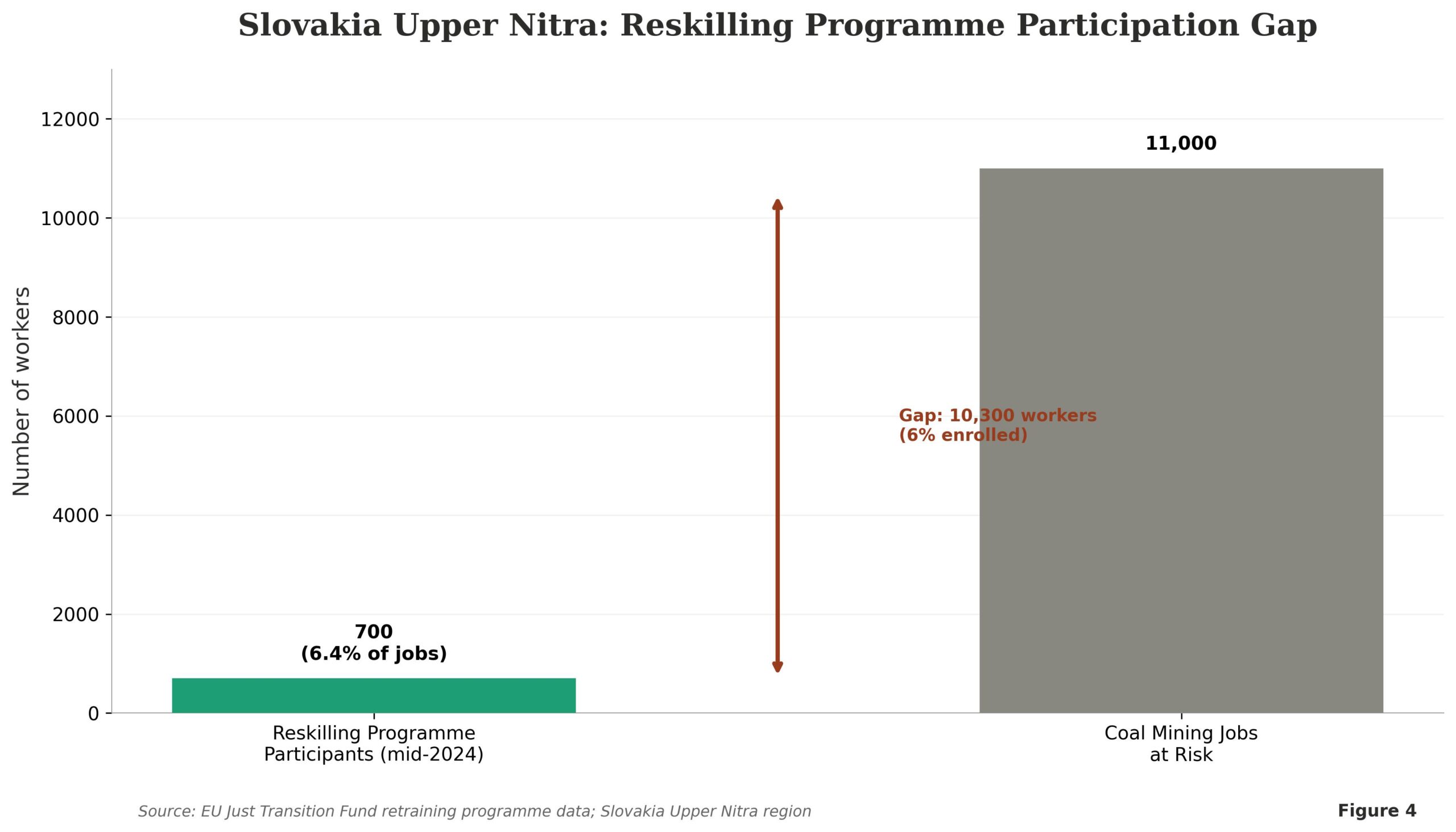
Moreover, the challenge of reskilling remains particularly pressing. Slovakia’s Upper Nitra region launched a retraining programme for former coal mine workers in 2023, funded with €12 million from the EU’s Just Transition Fund. It offers courses in areas from photovoltaic installation to electrical work, and by mid-2024, had over 700 participants. Although a meaningful start, it is modest relative to the scale of displacement the region faces, as nearly 11,000 jobs are dependent on the coal mining industry.
While Europe has the institutional capacity and financial resources to attempt a managed transition, the challenge looks different elsewhere. For fossil-fuel exporting states in the Global South, the stakes are much higher and the safety nets much thinner. A 2025 paper in Frontiers in Political Science noted that many major fossil fuel producers have limited governance infrastructure, fiscal capacity, and social protection coverage to manage displacement. Without meaningful international support, energy transition burdens developing countries. This imbalance can be further illustrated by the dependency theory, which highlights how historical patterns of colonial extraction and unequal global interaction have locked many developing nations into resource-dependent economic structures. As a result, developing states’ reliance on fossil fuels is not simply a policy choice, but a structural condition reinforced by external markets and domestic governance challenges (corruption), making just transition that much more difficult to achieve.
Overall, the pace and scale of the energy transition are shaping labor market conditions across multiple sectors and geographies. Policy frameworks under the ideal of just transition aim to manage this displacement through reskilling and training, social protection, as well as structured dialogue with affected workers. However, evidence from existing programmes suggests that outcomes vary considerably depending on the degree of institutional and financial support, as well as the involvement of labor and union organizations. Ultimately, achieving a truly just transition will not only depend on the speed of decarbonization, but also on the willingness of international actors to confront structural and global inequalities to ensure the costs of this transition are shared equitably, rather than placed on those most vulnerable.
Written by Isadora Zucker
References:
https://www.ilo.org/topics-and-sectors/just-transition-towards-environmentally-sustainable-economies-and-societies
https://www.iea.org/reports/ensuring-a-strong-labour-dimension-for-just-and-inclusive-energy-transitions/just-and-inclusive-energy-transitions
https://www.oecd.org/en/publications/providing-local-actors-with-case-studies-evidence-and-solutions-places_eb108047-en/reskilling-coal-industry-workers-for-the-renewables-energy-sector_9f6d4498-en.html
https://www.nature.com/articles/s41467-023-41133-9
https://newclimate.org/sites/default/files/2025-05/Report-Just%20Transition%20Policies%20-%20Lessons%20from%20Europe_20052025.pdf
https://www.tandfonline.com/doi/full/10.1080/14693062.2025.2460665#abstract
https://www.frontiersin.org/journals/political-science/articles/10.3389/fpos.2025.1536594/full
https://commission.europa.eu/strategy-and-policy/priorities-2019-2024/european-green-deal/finance-and-green-deal/just-transition-mechanism_en
https://jacobin.com/2024/03/just-transition-oil-workers-unions-california
https://iea.blob.core.windows.net/assets/d2b4b054-4a55-4c6f-893f-fc2c8b77e9a1/WorldEnergyEmployment2024.pdf