Industrial decarbonization is increasingly recognized as a decisive element in the global effort to achieve net-zero emission targets. In 2022 the manufacturing industries were estimated to produce up to 40% of global CO₂ emissions, corresponding to roughly 16 gigatons annually, highlighting the significant environmental impact of industry and reinforcing the need for coordinated actions to support the transition toward low-carbon models.
In this context, industrial decarbonization is the process of decreasing emissions generated by industrial operations while responding to sustainability objectives and regulatory obligations. Given the sector’s high levels of energy consumption and its contribution to overall greenhouse gas emissions, the transformation of industrial systems has become essential for achieving long-term climate goals.
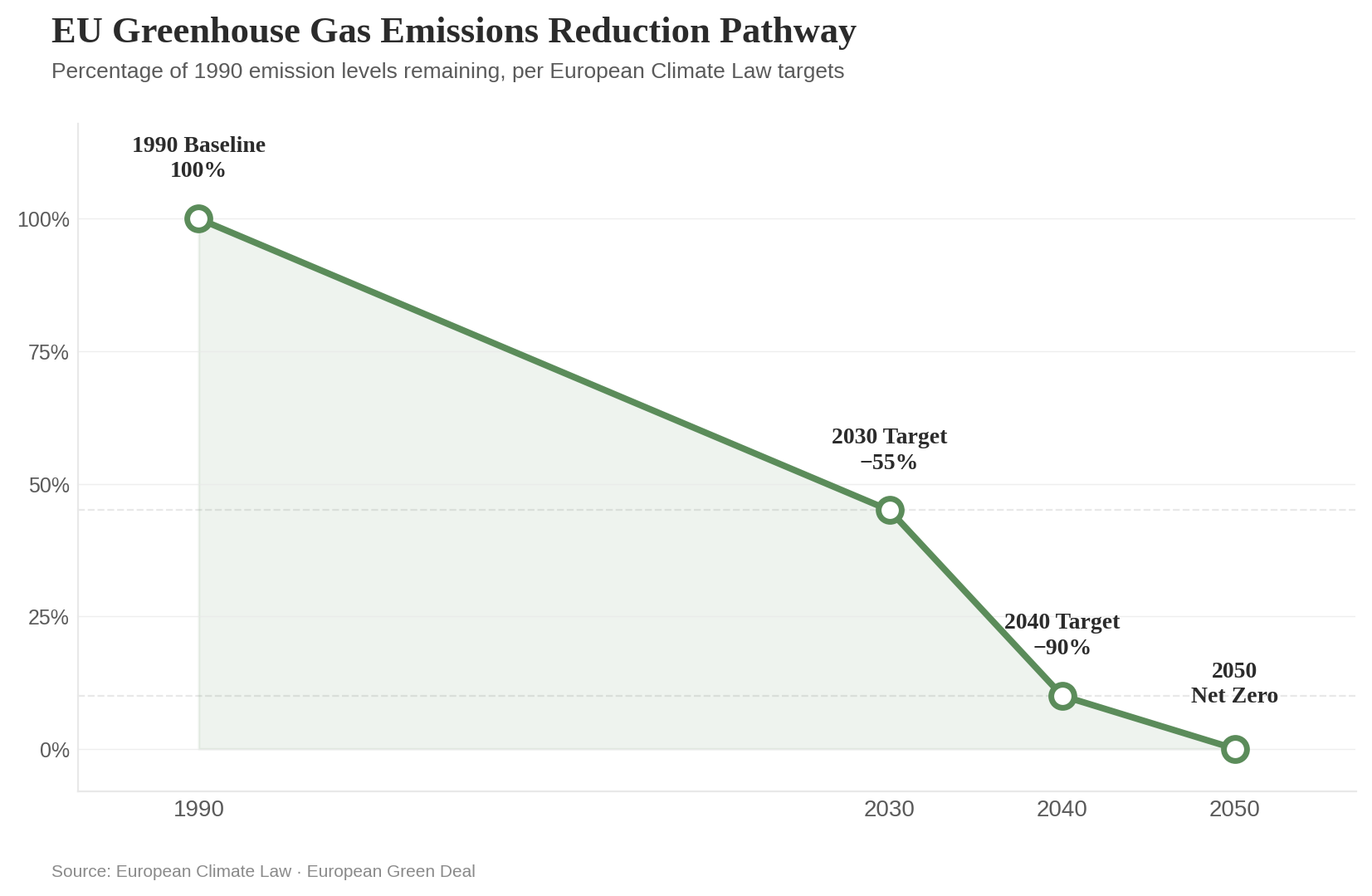
Within the European Union, this challenge is particularly relevant. The EU has set a target for the year 2050 to become climate neutral and achieve an economy with net-zero greenhouse gas (GHG) emissions. Under the European Climate Law, this target has been made legally binding. This makes industrial decarbonization crucial, as it plays a central role in the success of Europe’s broader climate transition.
A key pillar to meet these targets is the industrial decarbonization supported by initiatives such as the Clean Industrial Deal, launched in early 2025. The deal recognizes the critical support industries require to decarbonize; therefore, it introduces actions businesses can take and makes decarbonization a driver for growth. This deal indicates measures that can be adopted for diverse stages of the industrial value chain, although it presents a focus on current energy-intensive industries (like chemicals and metals), along with the clean tech sector. In doing so, it shows how it’s considering the current situation of industries and guiding them to a greener future, highlighting this sector as one of the main drivers of competitiveness for the industrial transformation.
While the primary target is 2050, the EU has also established key interim milestones. Under the European Green Deal, the bloc aims to reduce greenhouse gas emissions by at least 55% by 2030, relative to 1990 levels, followed by a 90% reduction by 2040. These intermediate targets are designed to ensure a steady trajectory toward net zero, embedding decarbonization into the EU’s industrial, energy, and economic planning at every stage.
Beyond its strategic vision, the Clean Industrial Deal outlines a set of operational instruments designed to facilitate the transition of the industry. One important dimension concerns the creation of market conditions that favor low-carbon products. Recent initiatives aim to raise the demand for sustainable industrial solutions by introducing environmental criteria in public procurement processes and by establishing requirements for large-scale foreign investments in key manufacturing sectors. For example, investment projects that exceed €100 million in areas such as critical raw materials, renewable technologies, and batteries are expected to generate economic value and contribute to employment creation and technological progress.
To support the transition, the deal commits to mobilizing over €100 billion in financial resources for clean manufacturing. A significant share is directed towards research and innovation; the Commission has launched a €450 million funding call under Horizon Europe targeting clean industrial technologies. On the investment side, the InvestEU Regulation was amended to increase the amount of financial guarantees that InvestEU can offer to support investments, which can fund up to €50 billion for the development of clean mobility, technology, and waste reduction. In parallel, the strategy draws attention to improved access to essential raw materials and the development of circular economy practices, with the objective of counting 24% of materials circular by the year 2030.
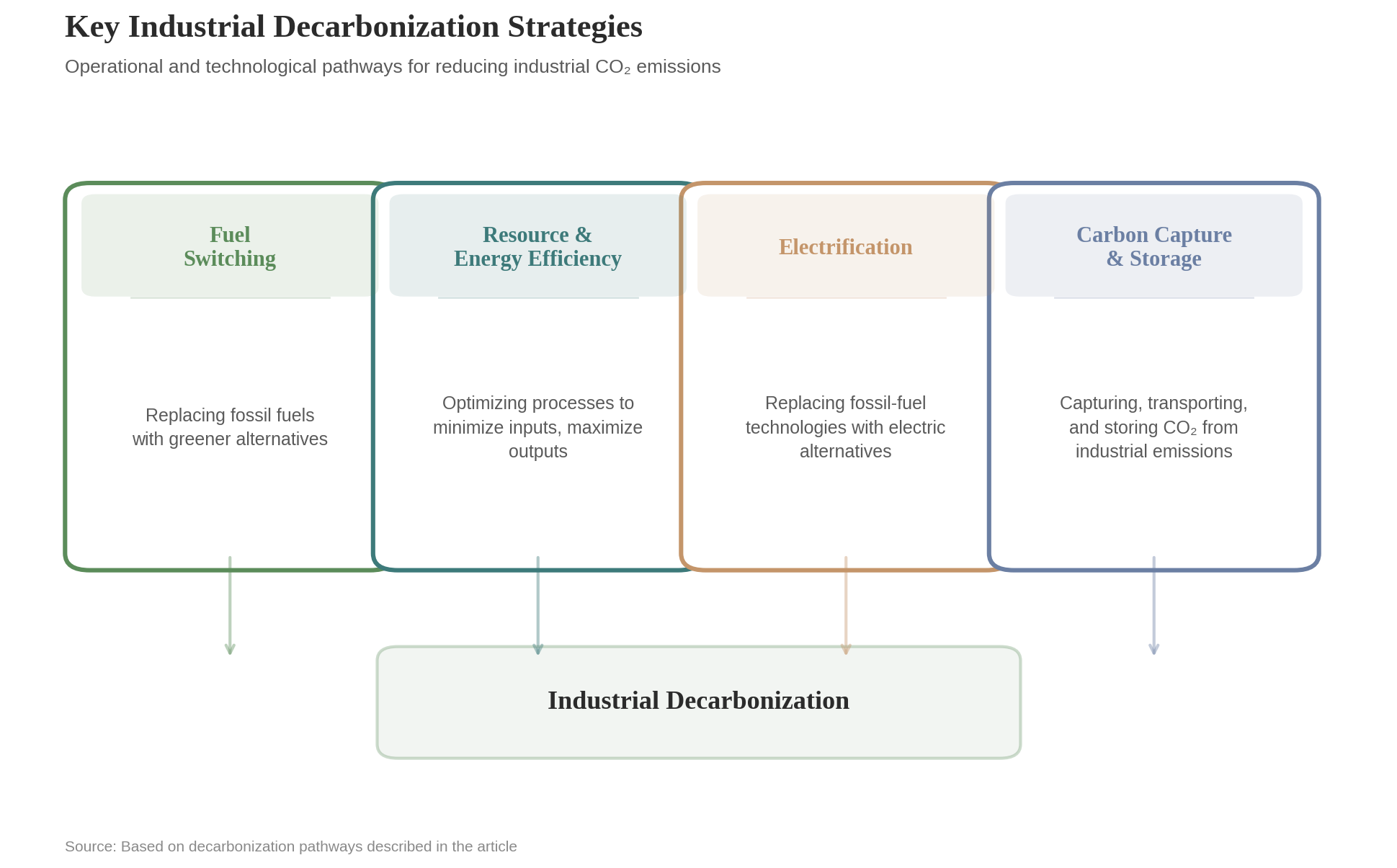
In addition to policy-driven instruments, industrial decarbonization also depends on technological and operational strategies implemented directly by firms. One relevant pathway is fuel switching, which consists of using greener fuel alternatives instead of fossil ones. Another approach is resource and energy efficiency, where industries change their processes to minimize their inputs and achieve, with that, the biggest quantity of outputs possible for a low-carbon functional system. Electrification is a process where businesses replace fossil-fuel-based technologies with electrically powered alternatives.
Furthermore, industries can implement carbon capture and storage (CCS), a process involving 3 phases: capture, transportation, and storage. In the capture phase, CO₂ is separated from industrial emissions using post-combustion, pre-combustion, or oxyfuel combustion techniques, with the choice depending on fuel properties, facility infrastructure, and cost considerations.The captured CO₂ is then transported to a suitable storage site. In the final phase, the CO₂ can be stored through methods such as ocean storage, mineral carbonation, or biological sequestration, with the aim of preventing its release into the atmosphere. In some cases, captured CO₂ can also be utilized in other industrial applications.
Overall, industrial decarbonization represents not only an environmental necessity but also a structural transformation of production systems and market dynamics. The transition towards low-carbon industrial models requires coordinated action between public policy frameworks and firm-level technological innovation, as well as substantial financial support and long-term strategic planning. Within the EU, initiatives such as the Clean Industrial Deal illustrate how climate objectives are increasingly integrated with industrial competitiveness, resource security, and economic resilience. As industries progressively adapt their processes, investments, and business models, decarbonization is expected to play a decisive role in shaping future growth pathways. Consequently, the capacity to successfully implement this transition will determine not only the achievement of climate targets but also the positioning of European industry in an evolving global economy.
Written by Arantxa Herberth Guerrero
References
https://climate.ec.europa.eu/eu-action/climate-strategies-targets/2050-long-term-strategy_en
https://commission.europa.eu/topics/competitiveness/clean-industrial-deal_en
https://commission.europa.eu/strategy-and-policy/priorities-2019-2024/european-green-deal_en
https://www.oecd.org/en/topics/sub-issues/decarbonising-industry.html
https://skyven.co/glossary/what-is-industrial-decarbonization/
https://www.prysmian.com/en/insight/construction-and-industries/what-is-electrification
https://europeanenergy.com/2026/03/04/sustainability-as-a-value-driver-from-day-one/
https://www.renewable-ei.org/pdfdownload/activities/REI_EU_IndustrialPolicyTrends_EN_202507.pdf