

The environmental consequences of fast fashion have been ubiquitously known for decades. With the mass production of cheap garments polluting the Earth seemingly beyond repair as a new fashion trend appears one after the other, it is clear that a radical solution is necessary to tackle this problem before it spirals irreversibly. A major driver behind the magnitude of the impact of fast fashion is a lack of data. Many recycling plants do not know the materials in a majority of textiles, making them impossible to recycle, companies avoid transparency at all costs to keep production affordable and keep up efforts of greenwashing, and many supply chains are impossible to be tracked. In an attempt to take control of fast fashion and get rid of ambiguity across the industry, in June 2024 the EU approved the Ecodesign for Sustainable Products Regulation (ESPR) framework. This framework puts into place the mandatory usage of Digital Product Passports, or DPPs, for any company selling apparel or footwear in the EU, regardless of where the company is based.
DPPs are essentially digital fingerprints for each piece of clothing, providing information regarding the item’s entire environmental impact and history instantly, just by scanning it. With the use of a simple tag with a QR code or an NFC tag, consumers and sellers will be able to immediately receive information on the product’s description, material composition, supply chain, transport, carbon footprint, social impact, circularity, health impact, costs, durability, and recyclability, among others. An example of a possible DPP is shown below.
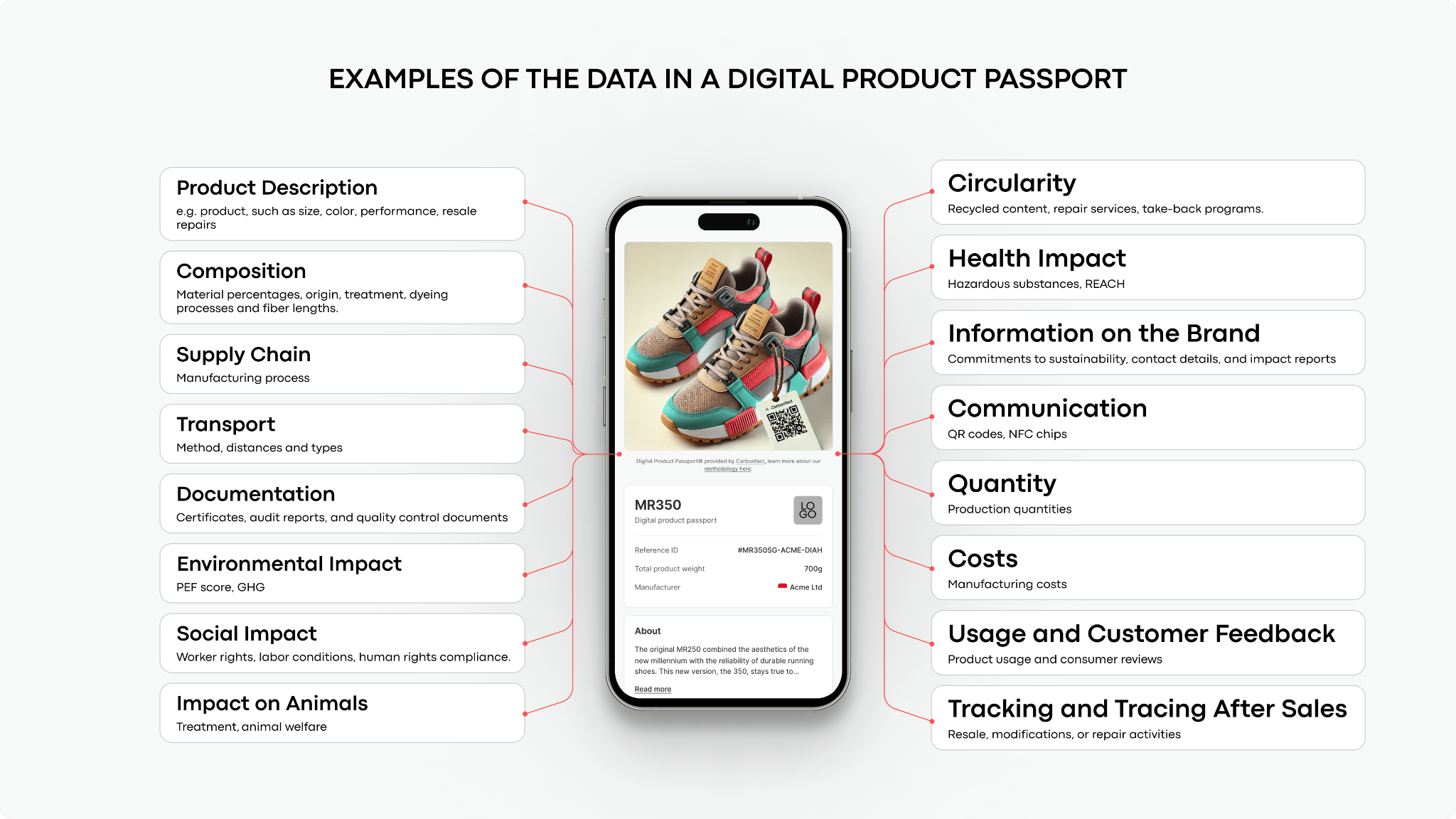
In this example, by simply scanning the tag on these shoes, everyone has access to more than a dozen details regarding all possible environmental impacts of the item. Under the ESPR framework, this product transparency will make it necessary for firms to strictly adhere to certain requirements and environmental regulations throughout the entire supply chain and manufacturing process. With DPPs, companies will no longer be able to shirk production standards and smudge the line of sustainability. DPPs are set to begin being mandated across the EU in 2027, with companies being given up to 18 months to implement their usage, which means a possible revolution in the fashion industry is forthcoming.
However, while in theory, DPPs are meant to create perfect traceability across the fashion industry, if not closely monitored, DPPs could just become a more complex way of greenwashing. First of all, although the ESPR framework aims to maintain complete honesty throughout the industry, in reality, DPPs will still rely on self-reporting from the brands and suppliers themselves. Therefore, they could technically easily falsify the details regarding their product. While there are other smaller issues regarding DPPs such as physical barriers to recycling and high production of low impact items, as the role of AI continues to dominate our society, DPPs are sure to be affected as well.
In order to obtain and automate the massive amount of information and data needed to apply DPPs to all their products, companies will no doubt turn to AI for assistance. While this will help speed up the process of initiating DPPs, at the same time, AI usage creates new risks. Because AI systems rely solely on the data that is inputted, if the input data is incomplete, biased, or intentionally manipulated by the companies, the outputs will reinforce those inaccuracies rather than correct them. This could in turn result in misleading environmental assessments being scaled across entire product lines. Furthermore, due to the opacity of many AI models, it makes it very difficult to verify exactly how conclusions are reached, which reduces trust and accountability in the fashion sector. As a result, instead of improving reliability, AI could unintentionally amplify errors and enable more sophisticated forms of greenwashing within DPP systems, communicating inaccurate information with widespread effects. Furthermore, some brands may also rely too heavily on AI tools, greatly reducing human oversight and actual critical evaluation of the information. This over-reliance creates the risk of DPPs turning into merely a step on the checklist for companies to get done with rather than an actual revolutionary tool to promote sustainability, where efficiency is prioritized over actual accuracy and environmental responsibility.
In a perfect world, DPPs would create the transparency necessary to radicalize sustainability in the fashion sector and force companies into minimizing environmental costs. However, in reality, DPPs don’t immediately lead to systemic change, they just create the basis for accountability and measure the fashion industry’s environmental impact. With the ever-growing influence of AI, these risks only grow larger, meaning DPPs have to be utilized in a very specific manner to truly have a meaningful impact. In order to truly capture the great potential of DPPs, they must be supported by strict regulation, independent verification, and real consequences; otherwise, they risk simply becoming a tool for marketing and greenwashing without actually creating any meaningful change.
Written by Maia Sikora
References
European Parliamentary Research Service. Digital Product Passport: Opportunities and Challenges. European Parliament, 2024. https://www.europarl.europa.eu/RegData/etudes/STUD/2024/757808/EPRS_STU(2024)757808_EN.pdf
Lüttin, Lidia. “Digital Product Passport for Textiles: What Fashion Brands Need to Know About the DPP.” Carbonfact, 5 Jan. 2026. https://www.carbonfact.com/blog/policy/digital-product-passport-fashion
Politecnico di Milano. Sustainability, vol. 17, no. 8804. 2025. https://re.public.polimi.it/retrieve/d8cfa00f-ab86-4b95-8a0d-747e6c810385/sustainability-17-08804.pdf