
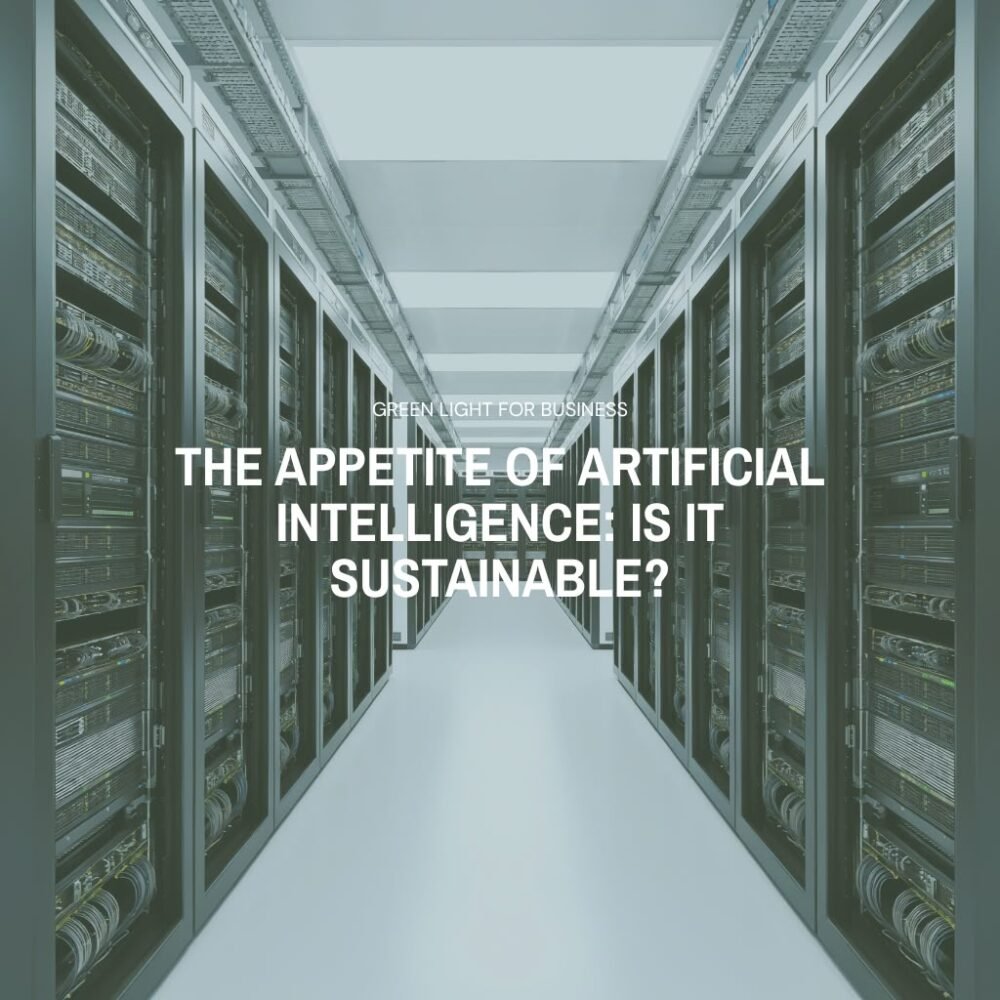
Artificial intelligence has come to dominate the technology sector. However, there is no AI without energy – specifically energy for data centers. With its rapid acceleration in development and uptake, and growing concerns about the ethics of its practices, it becomes necessary to raise the question: how can we make the technology that powers our future sustainable?
The International Energy Agency (IEA) projects that global data center electricity demand will more than double by 2030, and cooling these facilities is placing growing pressure on local water supplies, as well as the environment. Some argue this is a massive problem, as its efficiency and impact in developing industries encourage greater use, thus increasing its demand for resources. Others however believe that the same ingenuity driving AI will also deliver cleaner power, smarter cooling systems and a net reduction in emissions over time, helping mitigate the many problems climate change poses. In order to determine which side is right, we must look at the evidence.
AI is placing significant strain on energy generation and supply systems. As each AI task becomes more energy efficient, overall demand is rising due to rapid expansion. This expansion includes the construction of data centers, which are warehouses filled with computer servers that power the internet, and increasingly, AI. These servers generate heat, which requires cooling – a process that uses vast amounts of water and energy, thus prompting concerns over its sustainability. In 2025, electricity demand from data centers rose by 17%, far outpacing the 3% growth in overall global power demand. That same year, the facilities worldwide consumed 222 billion litres of water for cooling. This metric is expected to triple by 2030, creating vast discontent with the progressing technology as water is seemingly becoming a limited commodity. There is also an interesting trade-off that rarely gets mentioned – using less water usually means using more electricity. Although this might seem optimistic in the hope for more sustainable practices, companies are usually incentivized to use water as its usage is far cheaper than electricity. The electricity it requires is also not always retrieved with such green measures, highlighting the fact that some data centers need better cooling and reclaimed water (recycling), while others require cleaner power.
Despite its mass consumption, data centers are still only a small portion of global demand growth, less than industrial motors, air conditioning, and electric vehicles. So why is their presence so impactful, as opposed to other sources of technology or industry? The issue is its concentration. Data centers are typically clustered in regions, and as a consequence compete with businesses and homes for power and, again, water. This strains local electrical power grids far out of proportion to their global share. AI focused data centers use as much power as 100,000 households, and the largest ones currently under construction will use about 20 times that. In Ireland, data centers take up about 20% of metered electricity and about 25% of Virginia’s. Water usage and energy consumption is not the only part of its ecological and social footprint. Noise, heat, land use, construction, and local air pollution all affect nearby communities, continuing to feed angry public rhetoric.
At the same time, the pace of AI growth is already running into constraints due to shortages of critical infrastructure components, including gas turbines, transformers, and advanced semiconductors. These constraints may push the industry towards faster solutions, rather than those that are sustainable. In recent years, Trump made the expansion of AI a priority as he seeks to outcompete China on advanced technologies. This has led to concerns as officials argue that winning the race for AI is the reason to expand on fossil fuels.
So, despite its apparent tensions and dilemmas, how can AI become more efficient and sustainable? Researchers at the Grantham Research Institute estimate that AI, if harnessed in ways that would improve transportation, energy, and food production, could cut global climate pollution by up to 5.4 billion metric tons a year over the next decade. These reductions would outweigh even the expected increase in global energy consumption and emissions that would be created by running power-hungry data centers.
These figures however come with limitations. The study did not consider how efficiency gains could lead to increased consumption elsewhere, a pattern known as the Jevons paradox; when something becomes more efficient, we often end up using more of it. Even fully realized, the cuts would also fall short of the goal to keep global temperatures from rising more than 1.5 degrees Celsius.
This is where the government should come in. When it comes to the market and actions of companies, speed, cost, and practicality overtake sustainability, so government policy must make the sustainable option more viable, or perhaps more extremely, the only permissible one. Transparency of companies may be the first step. Microsoft and Amazon Web Services (AWS) report water-efficiency gains of 25% and 37% respectively, but with no industry wide reporting standard, comparison is difficult. Elon Musk’s SpaceX, which became a major data center operator after acquiring his AI company, has yet to publish an ESG (environmental, social, and governance) report. Standardized reporting would show which claims hold up, and would give local communities the information they need to advocate for themselves.
Policy can also reward better design, such as Nvidia’s DSX system (a new system for designing and managing AI data centers), which claims that it could almost eliminate water use and some facilities, and speed up approvals for clean generation.
Fatih Birol, Executive Director of the IEA, urges for closer cooperation between governments, grid operators and tech companies, highlighting that “countries that provide secure, affordable and rapid access to electricity will be one step ahead” as closer cooperation is needed to modernize infrastructure, make data centers more flexible, as well as manage costs. Grantham’s researchers also add that governments should regulate AI’s footprint through energy-efficient models and renewable-powered data centers.
Given the shortages in infrastructure and systems required to run AI currently, this is a perfect time for governments to take action so that the next steps of development will be clean.So, is AI’s appetite sustainable? Not entirely. While not incredibly promising, current demands and effects of AI’s consumption are proving harmful to the environment – data centers are straining local grids and water supplies, and shortages in infrastructure are tempting the industry towards faster, less sustainable options. The IEA fears that AI can accelerate climate change, yet it also highlights the large role it can play in solving it. As technology develops, efficiency gains and the use of cleaner power can ease AI’s footprint. However, whether AI’s progression leads to a cleaner future depends largely on policy and restrictions. AI can become more sustainable, but only if governments set clear standards and enforce them.
Written by Isadora Zucker
Bibliography:
- https://www.iea.org/reports/energy-and-ai
- https://www.investmentmonitor.ai/news/iea-warns-ai-could-double-data-centre-power-use-by-2030/
- https://w.media/data-center-power-demand-will-double-by-2030-iea/
- https://www.euronews.com/2026/09/07/tech-giants-claim-they-can-curb-ai-data-centres-thirst-for-water
- https://salatainstitute.harvard.edu/study-maps-water-footprint-of-ai-data-centers/
- https://www.datacentres.com/news/data-centre-water-consumption-reaches-5-6-billion-gAllons-annually-as-ai-boom-te-slot3-2026-06-28
- https://www.eenews.net/articles/ai-could-cut-more-emissions-than-it-creates/
- https://www.scientificamerican.com/article/ai-and-data-centers-could-cut-more-climate-change-causing-emissions-than/
- https://arxiv.org/abs/2501.16548
- https://www.nytimes.com/2026/07/25/opinion/data-centers-environment-ai.html